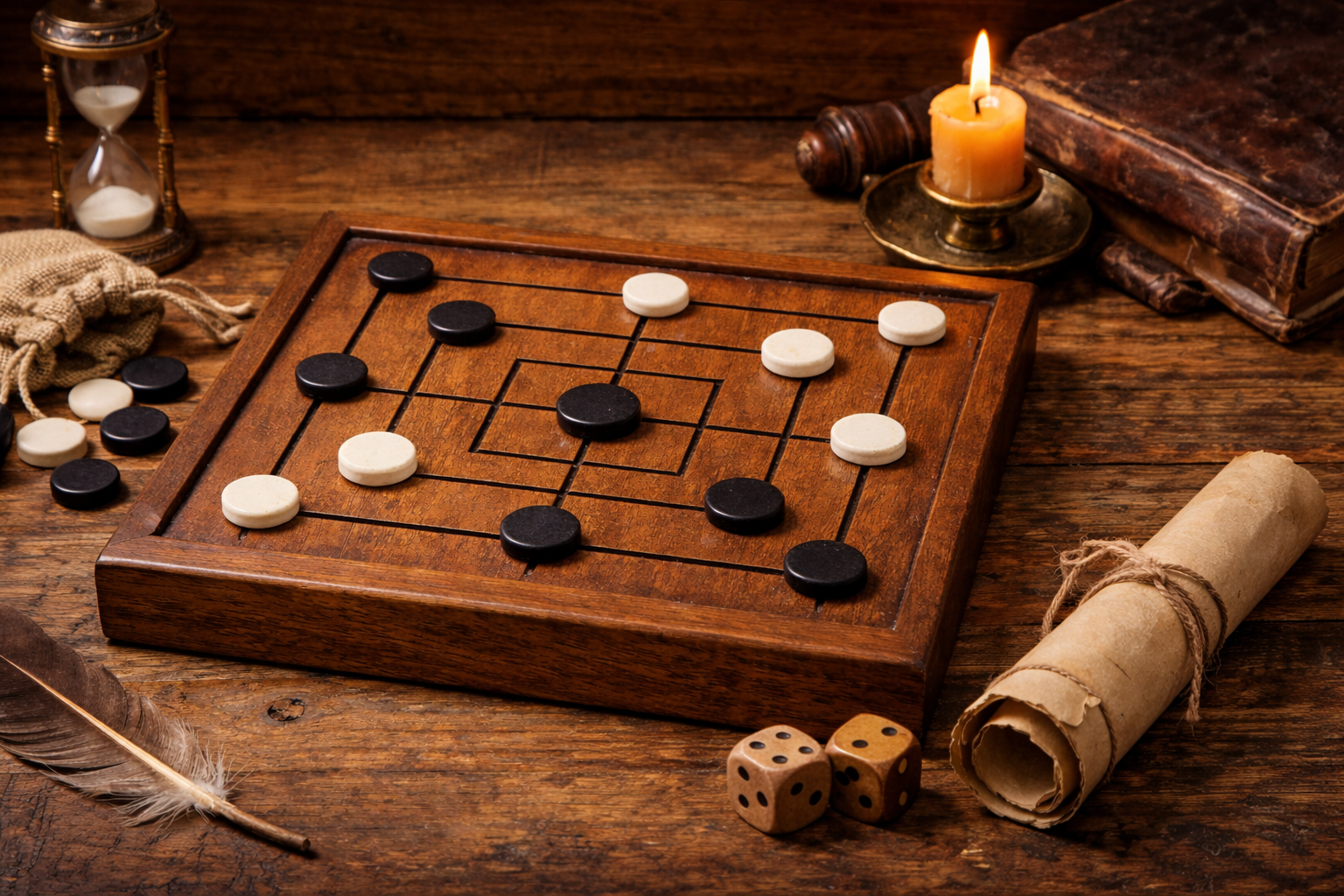
The Timeless Squares: Origins of the Mill
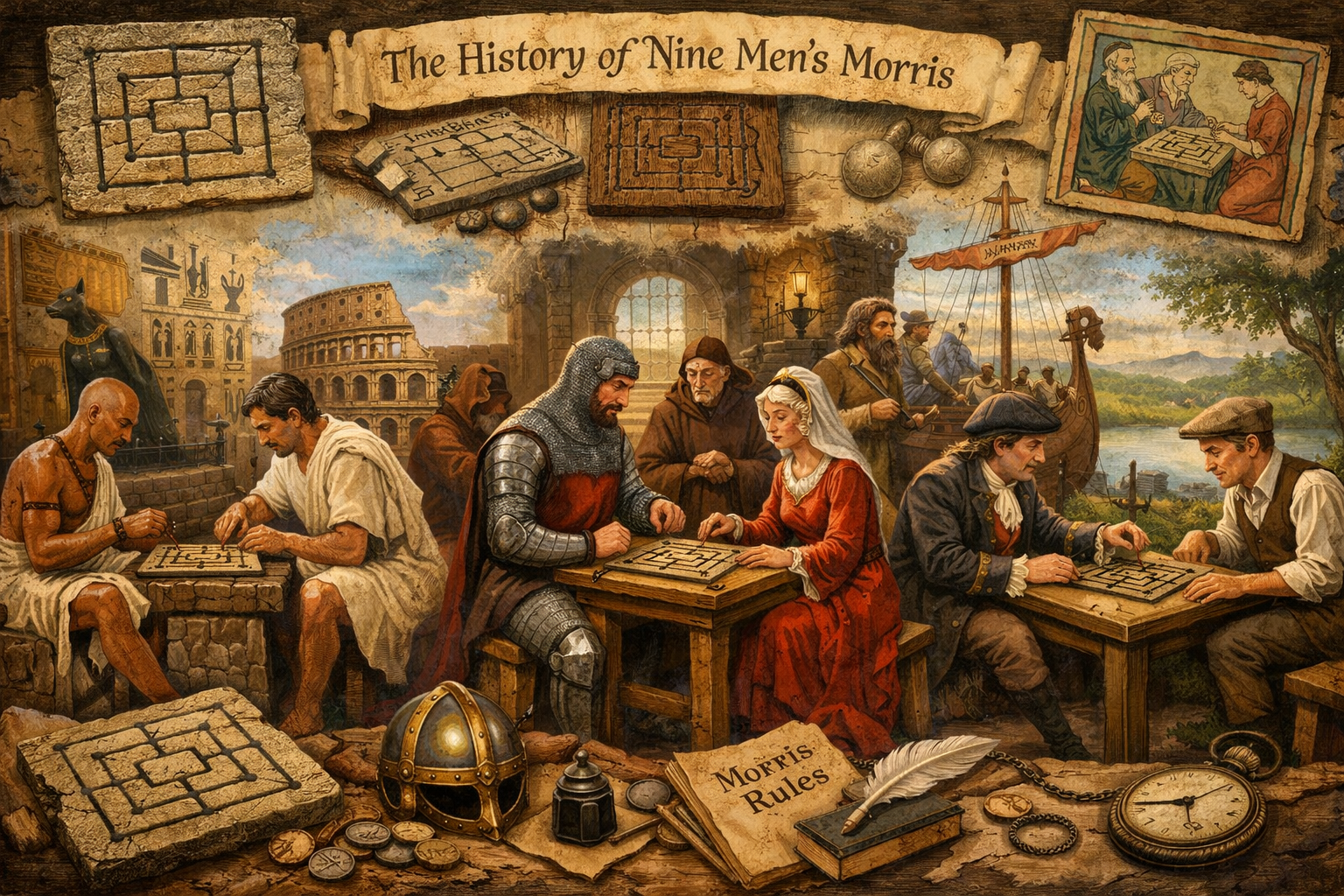
Deep in the sands of ancient Egypt, we find the roots of a game that has truly stood the test of time: Nine Men's Morris. Archaeologists discovered its characteristic square-within-a-square design carved into the roofing slabs of the temple at Kurna, dating back to 1400 BCE. It wasn't just a pastime for the elite; it was a game of the people. From the dusty streets of the Nile to the bustling Roman forums, soldiers and merchants alike would etch the board into stone or dirt. The Romans knew it as "merels," a word derived from the Latin for counters. It offered a mental escape during long sieges and quiet afternoons.
Its simplicity was its strength, requiring only a surface and stones. Yet, beneath that simplicity lay a mathematical depth that intrigued the brightest minds of antiquity. It bridged cultures and eras with ease. Travelers carried the rules along the Silk Road, spreading the fun. It is one of the oldest strategy games still played in the world today. Its journey from the Pharaohs to our modern screens is quite legendary.
Medieval Mastery and Shakespearean Mud
As the centuries rolled into the Middle Ages, the game's popularity soared across Europe, becoming a staple of tavern life and courtly play. Even William Shakespeare couldn't ignore its cultural footprint in England. In "A Midsummer Night's Dream," he lamented that "the nine men's morris is fill'd up with mud," showing it was often played outdoors in turf. Monks would carve the board into the cloisters of great cathedrals like Canterbury and Westminster, seeking a quiet diversion from prayer.
It was the "Checkers" of its day, accessible to both kings and peasants. Manuscripts from the 13th century detail complex strategies used by noblemen to outmaneuver their rivals in this "game of the mills." It provided a common language in a continent often divided by war. The board itself became a symbol of logic and orderly thought processes. Whether etched into a wooden bench or sewn into a fine cloth board, Nine Men's Morris was the heartbeat of social interaction for centuries. Its presence in medieval literature proves just how ubiquitous it once was.
The Art of the Mill: Strategy and Skill
The mechanics of the game revolve around the concept of the "mill," which is a row of three pieces along any of the board's lines. Players begin with nine pieces each, placing them one by one strategically. Once all pieces are on the board, the movement phase begins in earnest. Forming a mill allows a player to remove one of their opponent's pieces. This creates a high-stakes dance of offense and defensive positioning.
One of the most devastating maneuvers is the "seesaw" or "running mill." This occurs when a player can close two mills alternately every turn. It effectively dismantles the opponent's forces with relentless precision. The endgame changes again when a player is reduced to only three pieces. At this point, their pieces gain the ability to "fly" to any spot. This sudden shift in rules keeps the tension high until the final move. It is a game that rewards foresight and punishes impulsive decisions. Mastery requires understanding the geometry of the concentric squares. Every placement is a silent dialogue between two competing intellects.
A Global Family: Variations Across Borders
While the "nine" version is most famous, the game has many cousins. Three Men's Morris is a simpler variant, often compared to Tic-Tac-Toe. Six Men's Morris offers a tighter, more aggressive board for quicker play. Twelve Men's Morris adds diagonal lines, increasing the complexity tenfold. Different cultures have put their own unique spins on the core rules. In South Africa, a version called "Morabaraba" remains deeply popular. It features twelve cows instead of men and is played with great passion.
Each regional variation reflects the local environment and social needs. Some versions allow for more jumping, while others restrict movement. Despite these changes, the fundamental goal of forming a row remains. This versatility allowed the game to survive in diverse global climates. It proves that a solid core mechanic can adapt to any cultural context. Whether played with pebbles in the sand or ivory on a polished table, the spirit of the "Morris" family of games remains remarkably consistent. It is a testament to the universal human love for pattern and strategy.
The Digital Mill: A Legacy Solved but Loved
In the modern era, Nine Men's Morris has entered the digital realm. Computer scientists have used it as a benchmark for artificial intelligence. In 1993, Ralph Gasser "solved" the game, proving it ends in a draw. This assumes that both players make perfect moves throughout the match. However, for us mere mortals, the game remains as challenging as ever. It has found a new home in mobile apps and online gaming platforms. Schools often use it to teach basic logic and spatial reasoning skills.
There is something satisfying about its tactile history and clean lines. It reminds us of a time when entertainment didn't require electricity. The game serves as a bridge between our ancestors and our future. Its longevity is a rare feat in an industry obsessed with the new. As we look at the board today, we see more than just a simple game. We see a three-thousand-year-old legacy of human wit and competition. Nine Men's Morris is not just a relic; it is a living tradition. Long may the mills keep turning and the stones keep moving forward.